How Olympic Athletes Build Progression During the Off-Season
From preparing a trick to performing on the biggest stage in the world, we asked professionals what an athlete’s off-season looks like and what role airbags play.
When fans watch an Olympic halfpipe final, they see 90 seconds of perfection. What they don’t see is the off-season.
Behind every double cork, every triple flip, and every perfectly placed landing is a training structure that stretches across months and sometimes years. I sat down with world-renowned terrain park builder Charles Beckinsale and Canadian National Team Halfpipe Coach Trennon Paynter to discuss how essential off-season training is and what role airbags play in it.
Spoiler alert: airbags might be at the center of it.
Stage One: Trampoline Training and Building the Blueprint
Olympic tricks never start straight on snow. They start on a trampoline.
Trennon Paynter explains that trampoline training is the foundation of modern freestyle progression. “Athletes use trampolines to isolate specific components of a trick: rotation timing, air awareness, body position, and spatial control,” he told us.
He also added: “The goal here is repetition. On a trampoline, athletes can attempt dozens of rotations within a short session. This accelerates muscle memory and helps them understand how their body behaves upside down.”
But what are the limitations of trampolines, and what happens afterward?
We need to keep in mind: trampolines don’t replicate skis or snowboards on the feet. They don’t simulate vert takeoffs. And they don’t prepare athletes for the real speed and amplitude of halfpipe walls. They are limited when it comes to progression and this is when the next stage of training begins.
Stage Two: Dry Slopes and Airbags Build Progression
According to Charles Beckinsale, airbags have completely changed how the sport evolves.
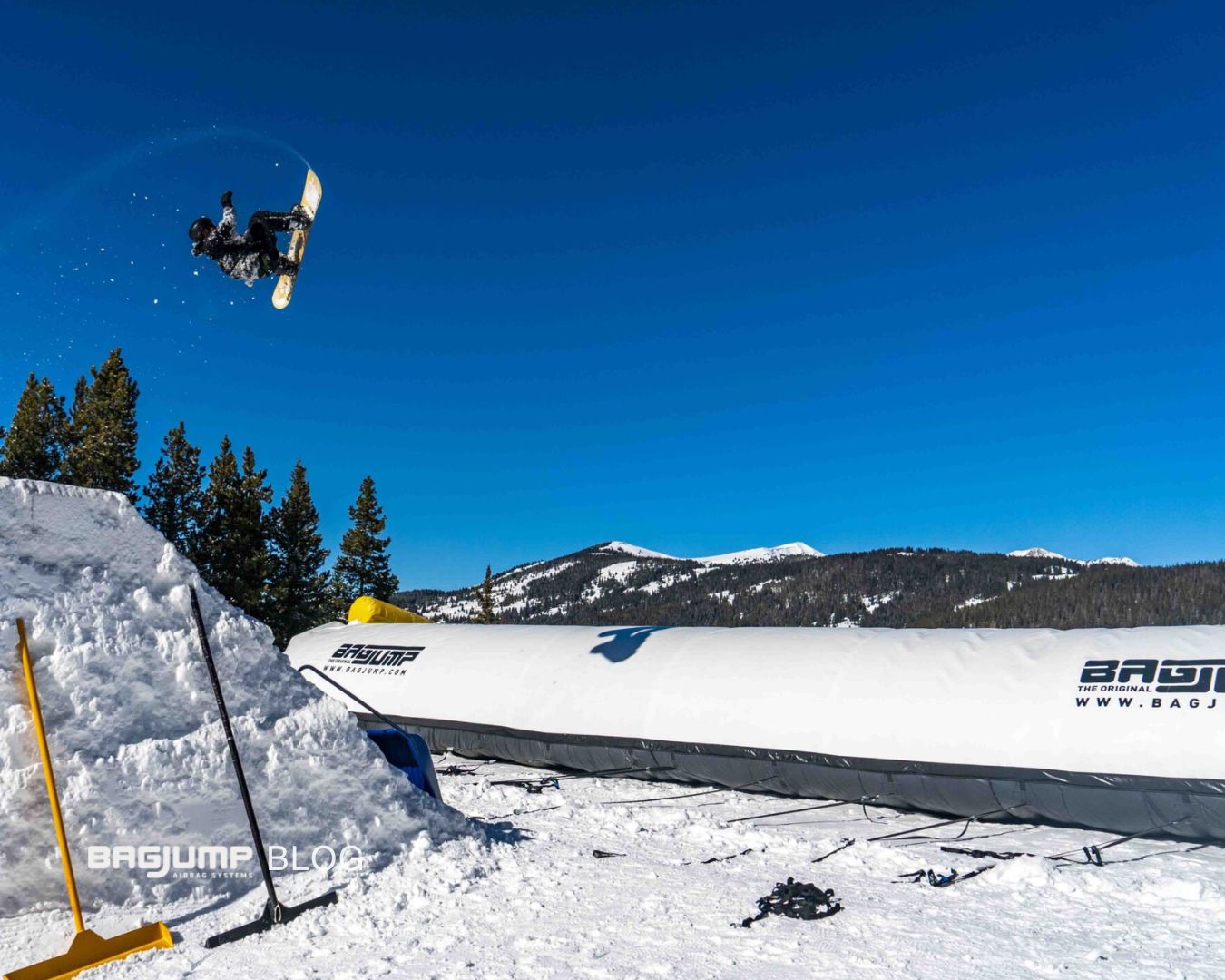
Airbags allow athletes to take trampoline-built fundamentals and apply them in real takeoff scenarios. This is the moment where progression becomes technical.
“When you add flips, especially moving from single to double or double to triple flips, that’s where you really need the airbag,” Trennon explains. “Every time your head goes underneath your body, the risk increases.”
“Rotation-only tricks—like adding a 180—can sometimes be tested without airbags. But flip-based progressions demand a safety buffer. The physical consequences of missing a double or triple flip on snow are simply too high,” he added.
On a Bagjump airbag, athletes go through two critical phases:
First: Can they execute the trick at all?
Second: Can they land it consistently in the same spot?
That second phase is where Olympic athletes separate themselves.
Consistency on an airbag builds the precision required for safe execution in a halfpipe. Charles emphasizes that airbags allow “endless tries and endless landings.” That repetition changes risk calculation entirely. By the time an athlete attempts a trick on snow, they’ve already mastered it in a controlled environment.
Once the tricks are tested enough, it is time to move to stage three.
Stage Three: Transfer to Snow
For slopestyle and big air athletes, the transition from a Bagjump airbag to snow can be relatively straightforward once landing consistency is achieved. The landing zones are larger and more forgiving.
With halfpipe, the game is totally different.
Trennon explains that even if an athlete lands perfectly on an airbag every time, there is still a “big step” to snow because the margin for error in a pipe is extremely small.
Airbags prepare the body mechanics, but once athletes reach snow, they are pushing to the next level. There, they must land in a very specific location to maintain flow into the next wall.
That’s why airbag training continues deep into Olympic preparation cycles. “Some athletes stop using airbags six months before the Games once their trick list is finalized. Others are still developing tricks just one month before the Olympics,” Trennon told me.
It depends on the athlete, the training schedule, and the trick they are practicing.
Why Airbags Accelerate Trick Complexity
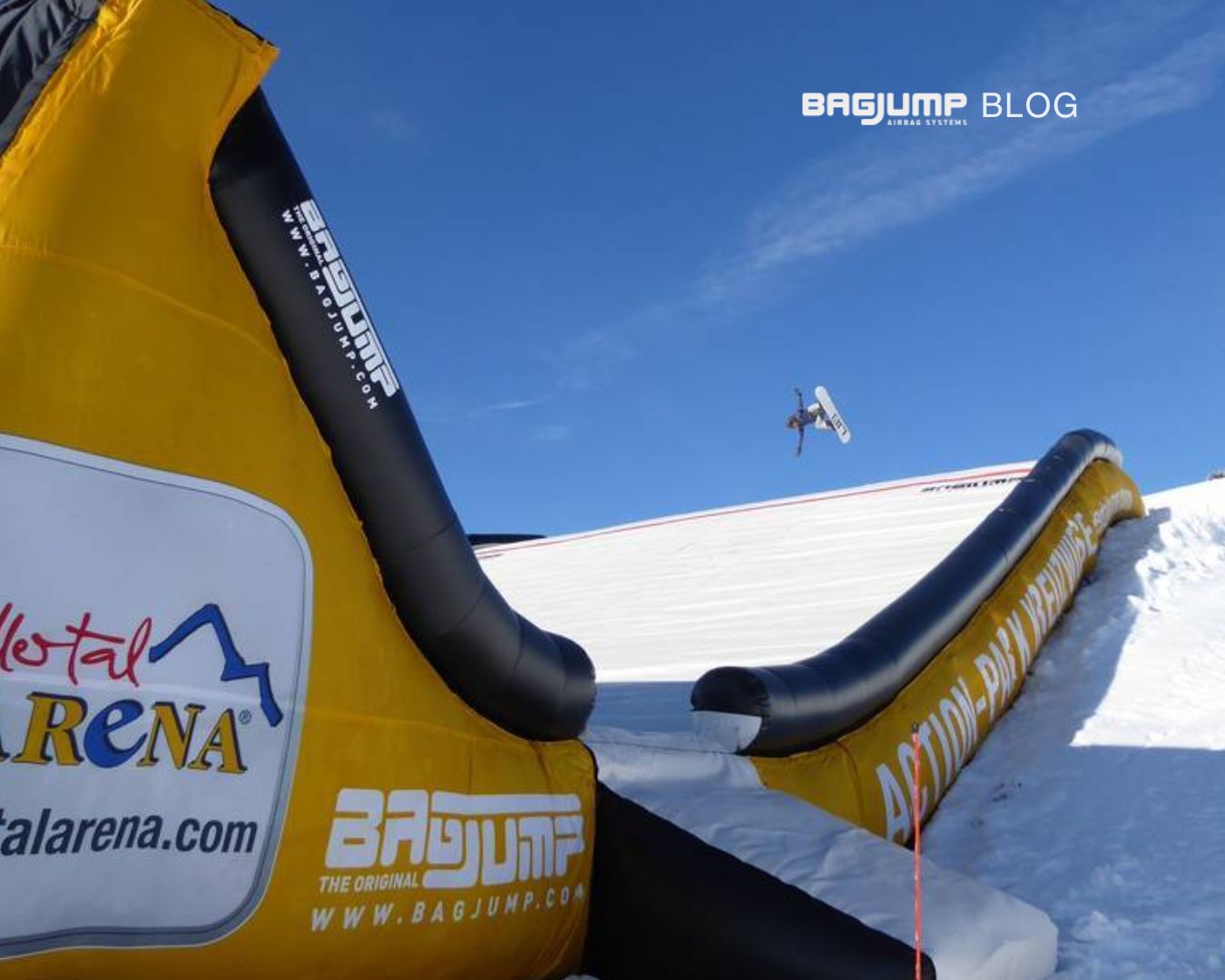
Ten years ago, many experts believed the sport had reached its technical ceiling. Today, that ceiling has already been surpassed, and we know that in ten more years, the tricks will reach another level we can’t imagine yet.
Charles has witnessed this progression firsthand. As a park builder and training facility expert, he sees how airbags allow athletes to push beyond what once seemed impossible.
He also explained the basic structure of attempting new tricks: “First, add a rotation. Then, add a flip. Add a combination and repeat safely.”
Let’s not forget: each added inversion increases risk exponentially. With airbag training, athletes are allowed to experiment without catastrophic consequences.
As Trennon puts it, airbags create “a bridge of both safety and progression between the athlete and the sport.”
That bridge is why trick complexity continues to grow, but injury rates don’t.
The Off-Season Is No Longer Off
Something I learned during my conversations with these experts is that an off-season is not truly a rest from training. Athletes no longer wait for winter to get back on their boards. With trampolines, dry slopes, and Bagjump airbags, training continues year-round. Facilities in Europe, North America, Australia, and New Zealand operate elite camps where national teams refine tricks long before snow arrives.
This infrastructure has professionalized freestyle progression. It’s no longer about bravery alone. It’s about structured development.
From Controlled Environment to Olympic Stage
When Olympic viewers watch athletes drop into a halfpipe, they are watching the final chapter of a long process.
They are watching: thousands of trampoline repetitions, hundreds of sessions with a Bagjump airbag, months of refinement, and countless controlled landings.
Trennon was very clear about the role airbags play: “I really don’t think that there are any athletes at an Olympic level without doing extensive training on airbags.”
The truth is that airbags are not a shortcut. They are a tool that allows athletes to increase trick difficulty while reducing unnecessary risk.
Without them, progression would slow. With them, the sport continues to evolve.
Now, watching the competitions in Cortina 2026, one thing is for sure: the off-season is where medals are built—and airbags played a big role in reaching them.
Read More